
This week’s roundup of data news includes highlights from March 7, 2026 to March 13, 2026, featuring robot rabbits that help capture pythons in the Florida Everglades and Google’s Gemini model predicting flash floods using historical news reports.
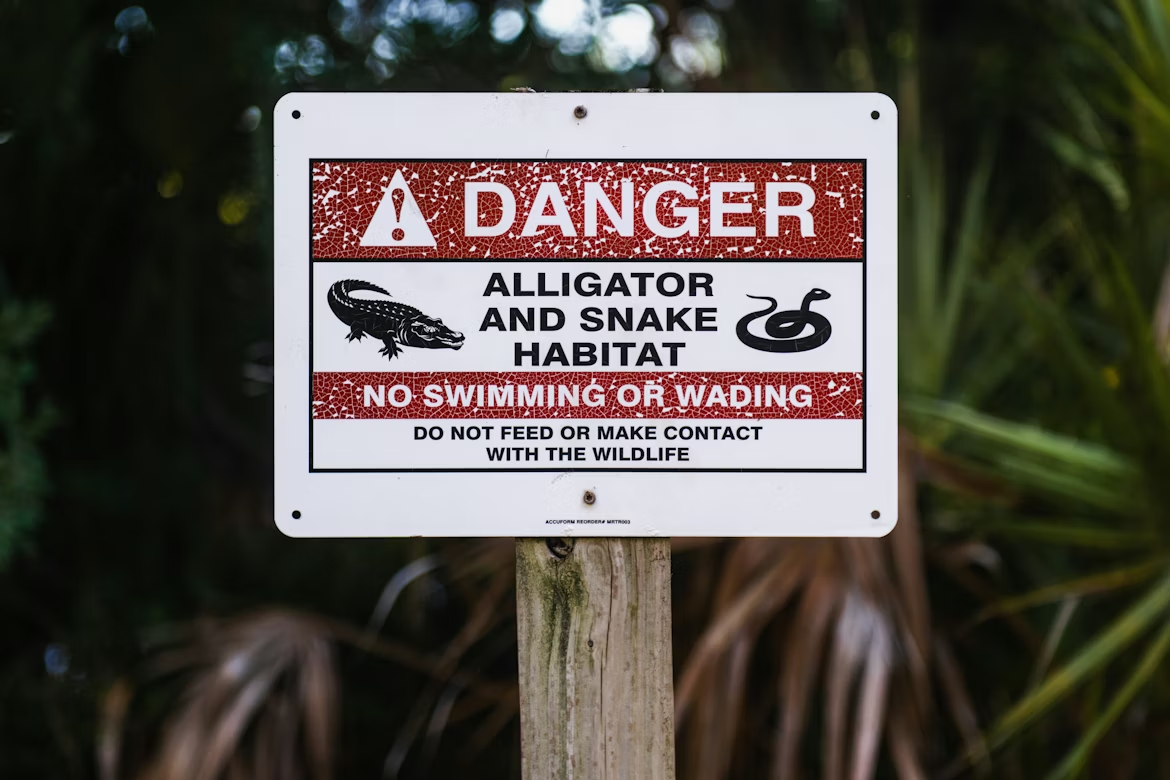
Researchers at the University of Florida and the South Florida Water Management District have built robot rabbits that lure invasive Burmese pythons, snakes that threaten native wildlife in the Everglades, out of hiding. The solar-powered decoys look, move, and smell like real marsh rabbits, attracting pythons. When a python approaches, onboard sensors and cameras detect heat and motion and send an alert so removal teams can quickly locate and capture the snake.
Researchers at the University of Vermont have created an AI-driven farming platform that helps growers monitor soil conditions, crop health, and environmental changes in real-time. The system combines satellite images of fields, field sensors, and AI models that analyze patterns in farm data to identify nutrient gaps, predict yields, and recommend targeted actions. It gives small farms practical guidance that helps them in the face of labor shortages and climate stress.
3. Creating Holographic Images
U.S.-based tech company Looking Glass has built a digital picture frame called Musubi that turns ordinary photos and videos into hologram-like 3D images. AI software first analyzes the image to identify the main subject and separate it from the background, creating layers that represent different distances in the scene. The device’s holographic display then renders those layers at slightly different angles so that, as viewers move, the scene appears to have depth behind the screen.
Google has used its large language model Gemini to analyze more than five million news stories about flooding and extract reports describing 2.6 million individual flood events. It turned these reports into a geotagged dataset called Groundsource, which records when and where floods occurred. Researchers then used this dataset to train an AI model that estimates where flash floods may occur in 20-square-kilometer areas. The model now supports flood alerts in 150 countries.
5. Tracking Vehicles Efficiency
Ford has created a new AI assistant for companies that manage fleets of Ford trucks and vans, allowing fleet managers to monitor driver behavior across many vehicles. For example, the system uses built-in vehicle sensors to detect when a seatbelt is unbuckled while a truck or van is moving. It sends an alert through Ford’s Pro Telematics dashboard, highlighting the vehicle, the time, and the driver so fleet managers can address safety issues quickly.
Students at Spelman College in Georgia have created an AI tool that helps people understand what their plants need by translating sensor data into simple messages. Called PlantGPT, it uses small soil sensors, probes placed in the soil, to measure moisture, light, humidity, and temperature. The AI tool analyzes these readings and gives alerts through an app on whether the plant is thirsty, too cold, or getting too much sun so users can care for it properly.
7. Finding Lost Household Objects
Researchers at the Technical University of Munich in Germany have built a robot that finds lost household items by combining a 3D camera with an AI model. The robot scans a room and builds a detailed 3D map of surfaces and objects. It uses computer vision to recognize items and an AI system that reasons about where people usually place them. By checking the most likely spots first, it finds objects about 30 percent faster than a random search.
Microsoft has created a new feature in its AI Copilot app called Copilot Health which lets users pull medical records from multiple providers and combine them with data from devices like an Apple Watch or Fitbit. The chatbot analyzes this information to highlight trends and surface potential health concerns. It then organizes the results into simple summaries and timelines that make long-term health trends easier to understand and follow.
9. Navigating Libraries Quicker
Harvard Library has integrated AI tools into the library’s online search portal that help its users search millions of books, archives, and digital files. The system uses natural‑language processing to interpret user questions and connect them to the most relevant parts of the library’s collection. It also uses software that turns scanned pages and handwritten notes into digital, searchable text, allowing researchers to uncover information that was previously buried in physical archives.
Researchers at the Royal Melbourne Institute of Technology in Australia have built a small robot, shaped like a dolphin and about the size of a sneaker, that cleans up oil spills on water. The robot uses a special filter coated with tiny, sea-urchin-like spikes that repel water but absorb oil. A pump pulls the oil through the filter into an onboard tank, allowing the robot to collect oil with more than 95 percent purity while remaining lightweight and reusable.


