
This week’s roundup of data news highlights from May 30, 2026, to June 5, 2026, featuring Amazon’s new warehouse robot that can understand verbal instructions and research testing a virtual-reality system to prepare robots for future missions on the Moon.
1. Improving Curb Management
The city of Houston has launched an AI-driven curb-management pilot called Smart Loading Zone to improve traffic flow and commercial deliveries. The program uses camera-based sensors and license-plate recognition to monitor vehicles in designated loading spaces and automatically bill drivers. The system identifies when vehicles arrive, how long they stay, and whether they are authorized, enabling more precise management of street-loading zones.
2. Speaking to Robots
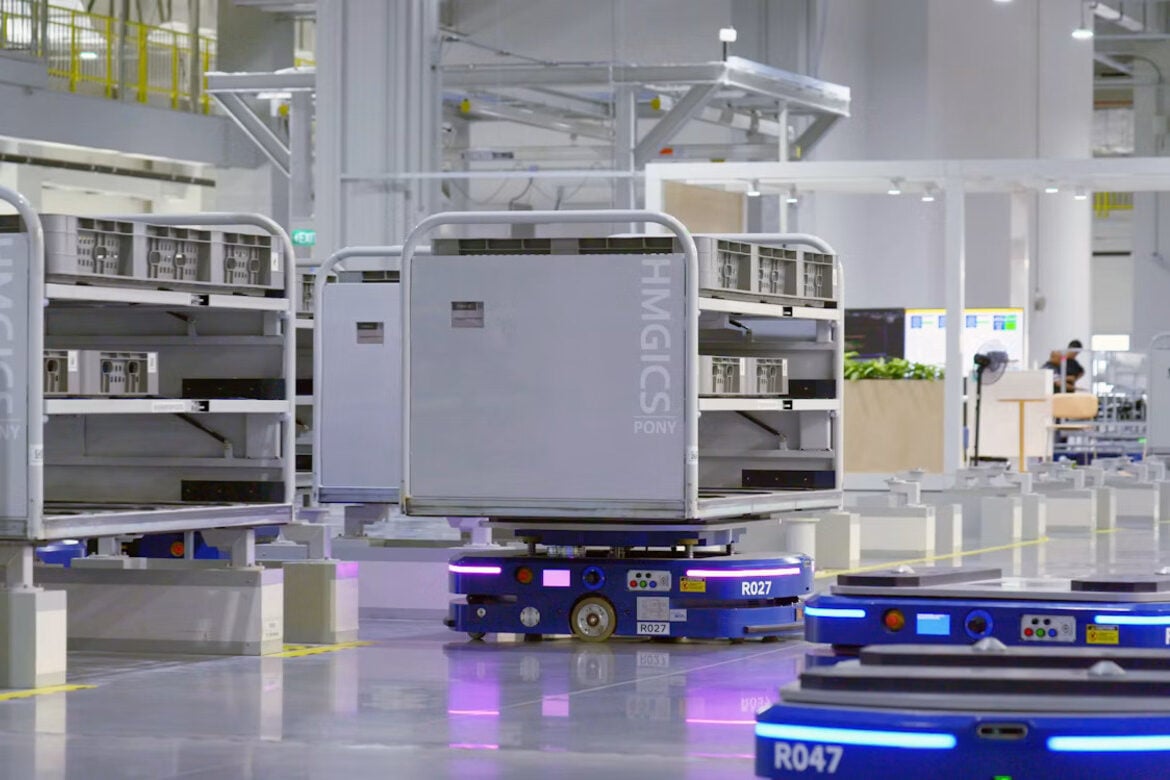
Amazon has announced a new version of its warehouse robot, Proteus, that can interact using natural-language commands instead of code. The AI-powered upgrade lets employees assign tasks verbally, allowing the robot to interpret instructions and determine priorities, routes, and timing on its own. The next-generation robot will also operate across larger areas of Amazon’s logistics network, moving containers and assisting staff throughout fulfillment sites.
3. Upgrading Soccer Rules
FIFA has created new semi-automated offside technology that will debut at the 2026 World Cup, aiming to speed up decisions and reduce lengthy delays before officials stop play. The system sends real-time audio alerts when a player is clearly beyond the offside line and uses AI-generated 3D player models and enhanced ball tracking to support video review officials. These tools help verify plays more quickly and improve the accuracy of close calls.
4. Enhancing Weather Forecasting
U.S.-based weather-forecasting company WindBorne Systems has created an AI forecasting tool called WeatherMesh-6 that outperforms leading forecasting systems. The AI system combines deep learning with real-time atmospheric measurements collected by hundreds of weather balloons. By feeding these observations directly into an advanced AI model, the system produces more stable and accurate medium-range forecasts.
5. Boosting Event Security
Boston Dynamics’ robot dog Spot has been deployed at stadiums preparing for the 2026 FIFA World Cup to support on-site security operations. The robots conduct perimeter inspections, assist teams in evaluating suspicious packages, and help assess potentially hazardous materials without putting personnel at risk. Spot can also navigate hard-to-reach areas and stream live video to security teams, expanding their ability to monitor venues safely and efficiently.
6. Preparing Robots for the Moon
Researchers at the University of Colorado Boulder have built a small three-wheeled robot called Armstrong to explore how humans might one day operate robotic systems on the Moon. The team pairs the robot with a hyper-realistic virtual-reality digital twin that allows operators to practice remote control in simulated lunar environments. These tests help researchers evaluate how astronauts could perform delicate tasks and maneuver equipment from a distance.
7. Predicting Hurricane Paths
The National Hurricane Center has started integrating AI models into its forecasting process to improve hurricane predictions. These systems analyze decades of atmospheric data and identify relationships among pressure, wind, temperature, and other weather variables to generate forecast guidance. By incorporating AI models alongside traditional forecasting tools, the agency aims to improve the accuracy of short-range storm tracking and intensity predictions.
8. Scaling Medical Guidance
Microsoft has partnered with the Mayo Clinic to build an AI chatbot trained on medical data and clinical expertise. The system is designed to support clinicians with specialized guidance and could eventually assist patients through Mayo’s online portal. By grounding the chatbot in anonymized patient records and specialty knowledge rather than general Internet content, the partners aim to deliver more reliable responses to complex health-care questions.
9. Precisely Eliminating Pests
Computer vision and robotics expert Steven Cheng has built a laser-guided mosquito killer that uses AI to detect, track, and eliminate pests with precision. He trained a deep-learning model on thousands of high-magnification mosquito images and paired it with a high-precision gimbal and laser system. A secondary wide-angle camera identifies people and flammable objects, automatically disabling the laser whenever it detects safety risks.
10. Detecting Scam Calls
Google has launched a new fake-call detection system for Android devices to protect users from AI-driven impersonation scams. The feature verifies incoming calls using a secure device-based authentication signal that confirms the call is originating from the expected device rather than relying solely on caller ID. If a scammer spoofs a trusted contact or uses a deepfaked voice, the system detects the discrepancy and immediately warns the user.


