
This week’s list of top data news highlights from January 17, 2026 to January 23, 2026, includes robots that speed up data‑center construction by automating concrete drilling and NASA’s new satellite system that tracks subtle ground movement to improve earthquake prediction in Southern California.
1. Tracking Expanding Algae Blooms
Researchers at the University of South Florida and the National Oceanic and Atmospheric Administration (NOAA) have built a deep‑learning AI model that scans satellite images to spot algae blooms on the ocean’s surface, which often appear as single pixels too small for humans to detect. The model scanned 1.2 million satellite images spanning more than 20 years to identify five types of algae across 13 zones in the Tropical Atlantic and Western Pacific. Researchers are using the findings to map algae bloom trends and understand how agricultural runoff, ocean warming, and other human‑driven factors affect ocean health.
2. Detecting Wildfire with Smart Cameras
Energy company, Xcel Energy, has installed dozens of AI-powered wildfire cameras, called Pano AI, across its fire-prone infrastructure in Texas to speed up emergency responses to wildfires. The cameras sit on tall structures, such as powerlines, and can see more than 100 miles with a 360‑degree view. An AI system automatically detects smoke, triangulates the fire’s location, and alerts first responders. Xcel also plans to expand the system across other Texas regions facing yearly wildfires to help strengthen land protection and save lives.
Researchers at the Swiss Federal Institute of Technology Lausanne have built a robotic hand that can detach from its arm and autonomously crawl across surfaces to retrieve objects. The hand has six identical fingers arranged in a spider-like layout, allowing it to grip multiple objects from any direction and use the other fingers as legs to move, before reattaching to its base. The hand uses a motion planning algorithm—software that calculates how it should move—to map its finger placement, balance, and identify the safest path across a surface. Researchers say this approach helps robots reach tight or hazardous spaces where fixed‑arm designs fail.
4. Speeding Up Data Center Construction
U.S.-based power equipment company DEWALT and robotics firm August Robotics have created an autonomous drilling robot that accelerates downward concrete drilling, a labor‑intensive step in data center construction used to anchor server racks and overhead infrastructure. The robot uses onboard sensors, computer vision, and AI‑guided positioning to scan and build a detailed map of the floor, identify exact drill locations, and continuously correct and adjust its placements as it works. This creates a level of real-time precision that reduces human error and delivers more consistent accuracy than manual building.
Adobe has released an update to its Acrobat AI Assistant that turns documents into audio summaries and also provides overviews, answers questions, and generates insights without requiring users to search manually. The tool interprets text, tables, and images, allowing users to ask questions and receive clear, contextual responses. The assistant also supports shared digital document hubs, called PDF Space, where it helps users analyze collections of documents, identify patterns or gaps, and cite specific sections when suggesting follow‑up actions.
6. Helping Stroke Survivors Speak Again
Researchers at the University of Cambridge have created a neck‑mounted wearable device called Revoice to help stroke survivors with dysarthria, a speech disorder caused by weakened or uncoordinated speaking muscles. The device uses ultra‑sensitive sensors to detect tiny throat‑muscle vibrations and pulse signals, which two AI systems process: one reconstructs silently mouthed words in real-time, and the other expands short phrases into full sentences by interpreting emotional cues and context. A connected phone or small speaker plays the generated speech aloud, allowing listeners to hear the user clearly.
7. Launching a Satellite Network to Rival SpaceX
Aerospace company Blue Origin has announced a satellite network, called TeraWave, built to rely on more than 1,300 satellites to provide faster global connectivity than existing networks. The network uses optical‑laser links for fast, secure data transfer across datacenters and businesses. The company plans to position TeraWave as a next‑generation option for high‑bandwidth, mission‑critical communications.
8. Improving Prosthetic Grip Strength
Researchers at China’s Guilin University of Electronic Technology have built a control system for a prosthetic hand that helps amputees automatically apply the right amount of grip strength when handling everyday objects. Unlike current prosthetics that rely on electromyography sensors—devices that read tiny electrical signals from muscles to estimate intended force—this system uses a palm‑mounted camera and fingertip pressure sensors to identify an object and predict the ideal grip force. By combining visual cues with real‑time force feedback, the prosthetic adjusts instantly for items like eggs, cans, or bottles, making hand use more natural and intuitive.
9. Revealing How Bats Find Insects
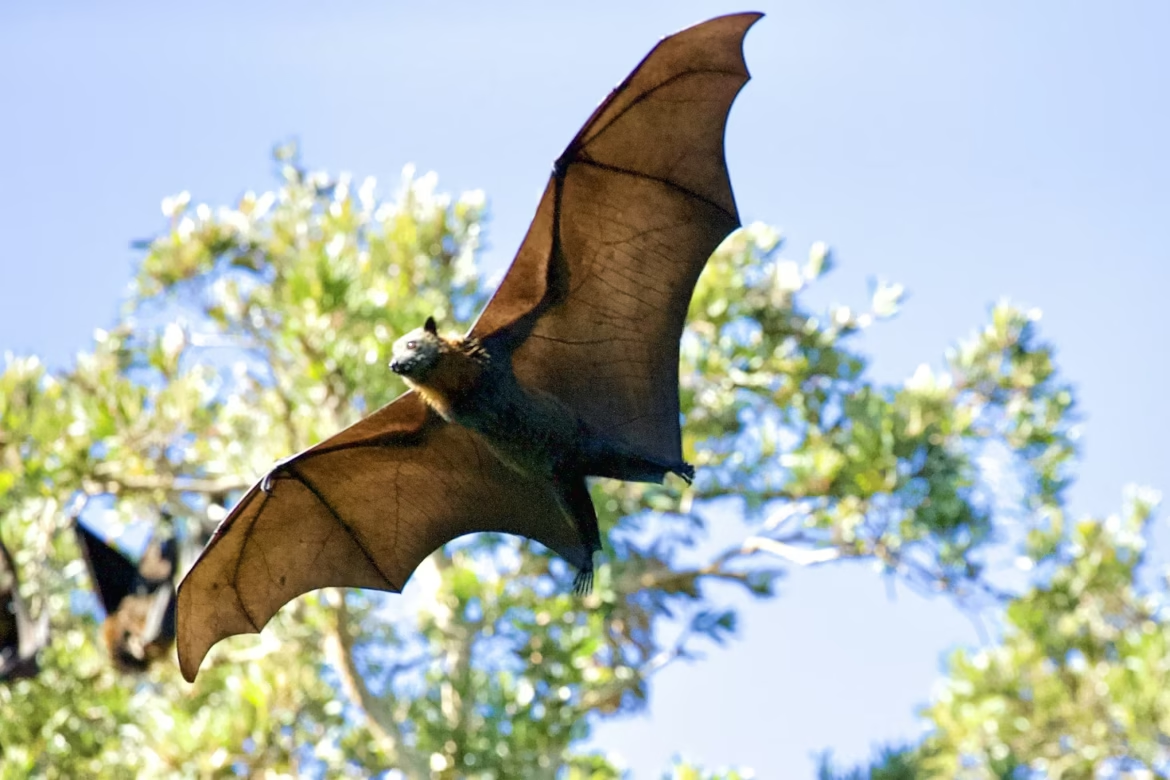
Researchers from the Smithsonian Tropical Research Institute, the University of Cincinnati, and the University of Antwerp have built a robot that mimics how big‑eared bats hunt insects in total darkness to test whether rhythmic head movements improve echolocation accuracy. They used a movable ultrasonic emitter and microphone array to reproduce the bat’s scanning motions and measure how echoes changed. The team showed that this active motion significantly sharpens an ability to pinpoint tiny prey at night and helped explain a long-standing question in bat behavior.
10. Mapping Earthquake Formation Risks
Scientists at the federally funded Jet Propulsion Laboratory have started using a new NASA satellite, equipped with a sophisticated radar instrument, to track subtle ground movements along Southern California’s earthquake‑prone faults. The satellite’s radar system uses interferometry, a technique that compares radar images taken at different times to detect millimeter‑scale changes in the Earth’s surface. By mapping how the ground shifts, researchers identify which fault segments are locked, slipping, or accumulating stress. The system’s precision offers scientists’ a new understanding of how seismic pressure builds and releases across the region.


