
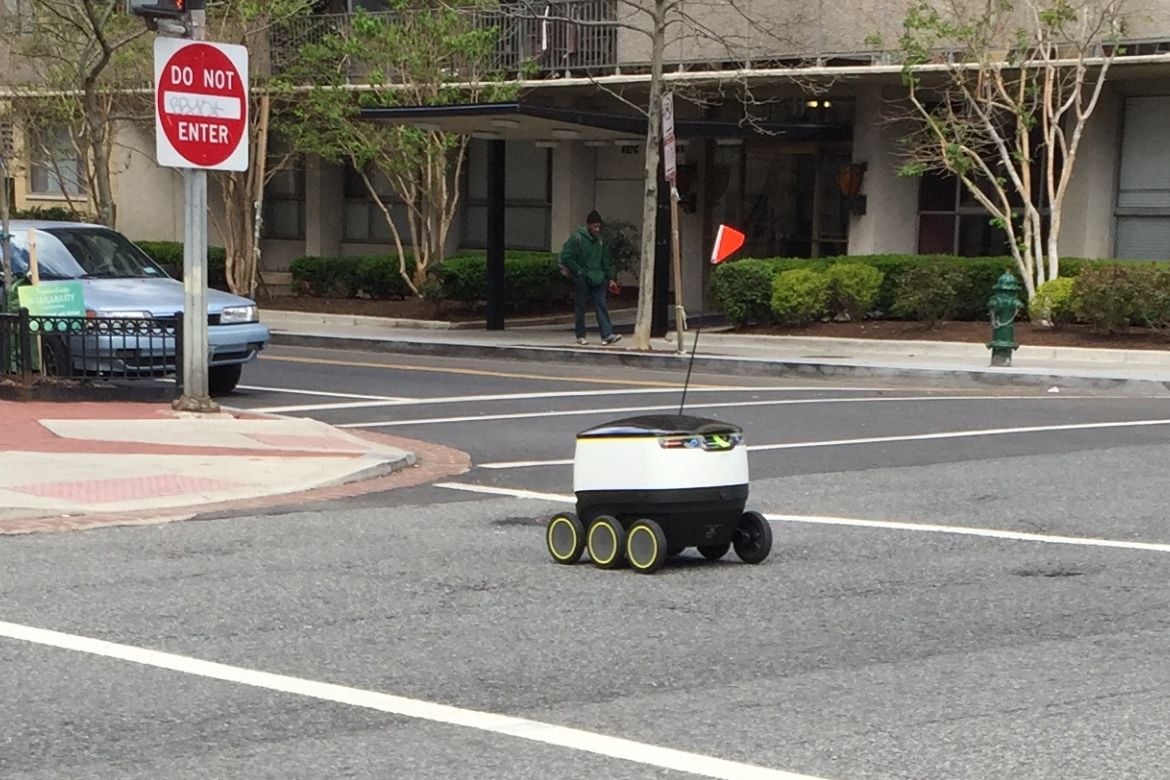
China’s autonomous delivery sector has earned its hype. Sidewalk robots deliver packages in dozens of Chinese cities faster than humans could, and China leads the world in the sector in both technological diffusion and market size. While the United States is keeping up in terms of technological development, it is falling behind in adoption because China has been more innovative, daring, and cohesive in sidewalk robot policy design. U.S. state policymakers should learn from China’s sidewalk robot policies.
The case for sidewalk delivery robots is straightforward: As e-commerce has grown, consumer demand for faster and more predictable delivery has increased, placing an unsustainable burden on delivery workers. These high-workload and high-turnover jobs present outsized health and safety risks. Sidewalk robots, whether fully autonomous or working alongside humans, can help alleviate rising delivery demand, reduce costs, and improve worker conditions.
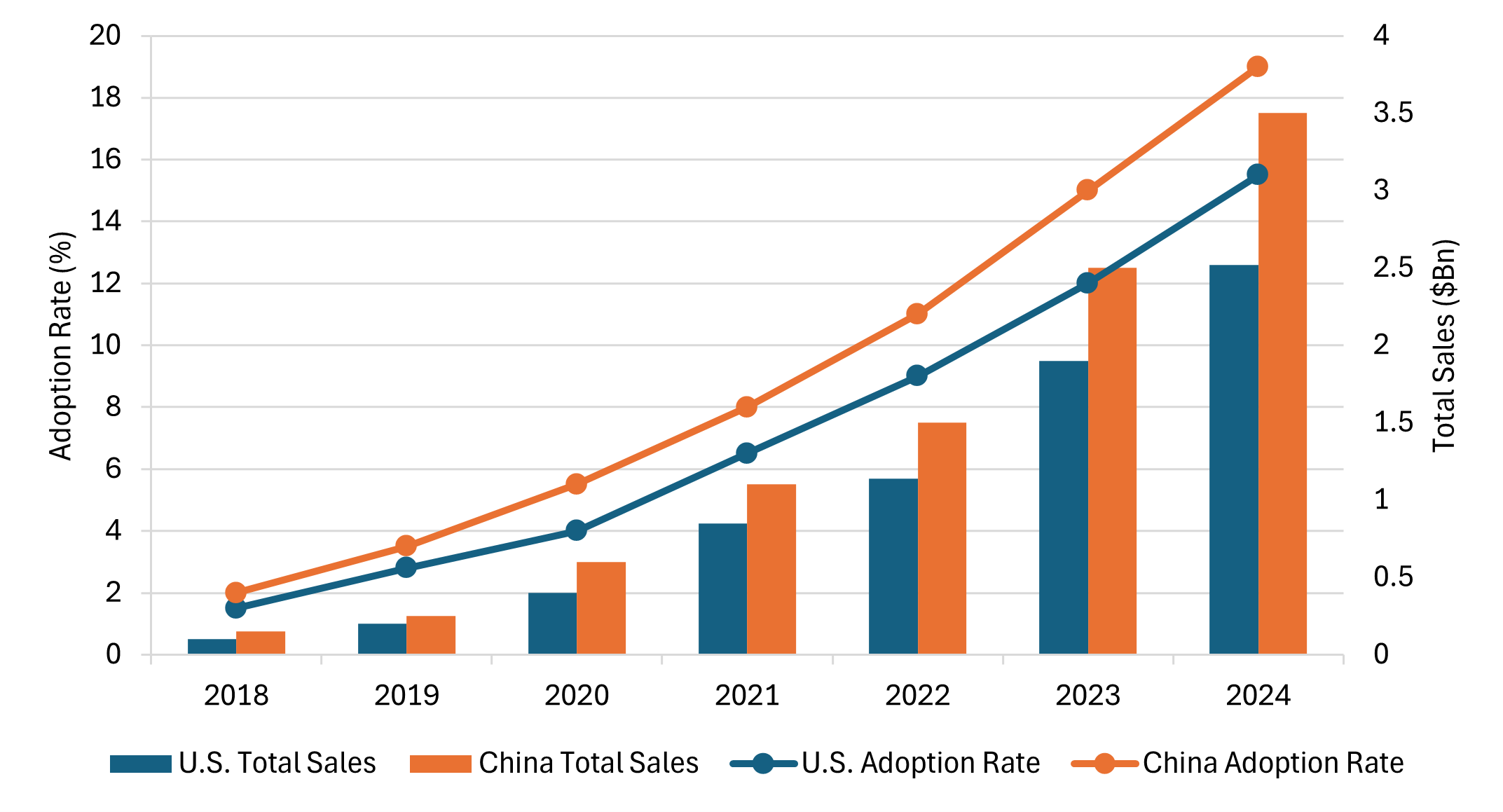
Yet, compared to China, U.S. adoption lags. A recent academic study found that in 2018, China and the United States were roughly neck-and-neck in both adoption rate, as measured by the percentage of businesses that have implemented autonomous delivery, and total sales in the autonomous last-mile delivery sector. But by 2024, China had pulled ahead in both, as shown in Figure 1.
Figure 1: Adoption and total sales of autonomous last-mile delivery in the United States and China, 2018-2024
 The United States is not falling behind due to a lack of research, capital, or commercialization. Major food delivery companies, such as DoorDash, Uber Eats, and Grubhub, already partner with robotics startups to bring sidewalk delivery to customers. The technology is mostly ready, but state policy is not.
A 2021 analysis of U.S. state policy for sidewalk robots found that most states have chosen to do nothing. Five years later, not much has changed. Tennessee recently granted personal delivery devices all the rights of pedestrians or bicycles. Georgia just passed a bill that would nudge its speed limit for personal delivery devices from four to seven miles per hour. Smaller cities like Jackson, Wyoming, and Knoxville, Tennessee, have outright banned sidewalk delivery robots, and major cities, including Chicago and San Francisco, have pushed back or tightly restricted the technology.
Sidewalk robot deployment presents real safety risks in urban environments. Too many could lead to injuries and crowding of pedestrian spaces, especially as robots grow larger and faster. But the answer is not more research before deployment, as some have called for. Robust academic research already exists. Instead, states need data from real-world implementation, coupled with iterative policymaking.
China could provide a road map forward. In policy directed at sidewalk robots, as well as other future industries, it has shown a greater willingness to govern emerging technology rather than ban or ignore it.
For example, the municipality of Beijing established a 225-square-kilometer Policy Pilot Zone to act as a laboratory to “speed up the innovative development of intelligent connected vehicles” and “actively promote the comprehensive commercial operation of application scenarios such as unmanned delivery” without risking safety. This approach allows regulators to learn from real-world data as the technology develops.
Beijing’s safety, regulatory, and testing standards are far more granular than what most U.S. states have considered. Beijing is also building smart sidewalks with roadside sensors to help robots better avoid pedestrians, subsidizing high-liability insurance for operators, and ensuring that sidewalk delivery policy coherently and simultaneously addresses cybersecurity, jobs, and urban planning.
Beijing is a dense, tech-forward megacity with significant resources. States that see it as too different from their own circumstances should look beyond the capital: even some of China’s less tech-advanced provinces are outpacing America’s most advanced states. For example, a city in Shanxi province, which China’s government labelled in 2025 as the country’s third-lowest region in science and technology innovation level, began building a city-wide intelligent intersection system in 2022. By 2025, the system was enabling robots to deliver an average of 2,500 orders per day, reducing costs by 50 percent compared to manual labor, and replanning routes in real time based on road conditions.
Sidewalk delivery robots are coming. The question is how quickly and smoothly the United States deploys them. Lawmakers should avoid a fragmented, state-by-state approach that creates conflicting rules and slows adoption. Because they operate on pedestrian infrastructure, they sit outside existing federal motor vehicle safety law and leave a gap in national oversight. Congress should set baseline standards for safety and interoperability, using lessons from states to inform a national approach. For policymakers at every level, the smartest way to move forward is to learn from a country that already has.
Image credit: Joe Warminsky/Flickr


