
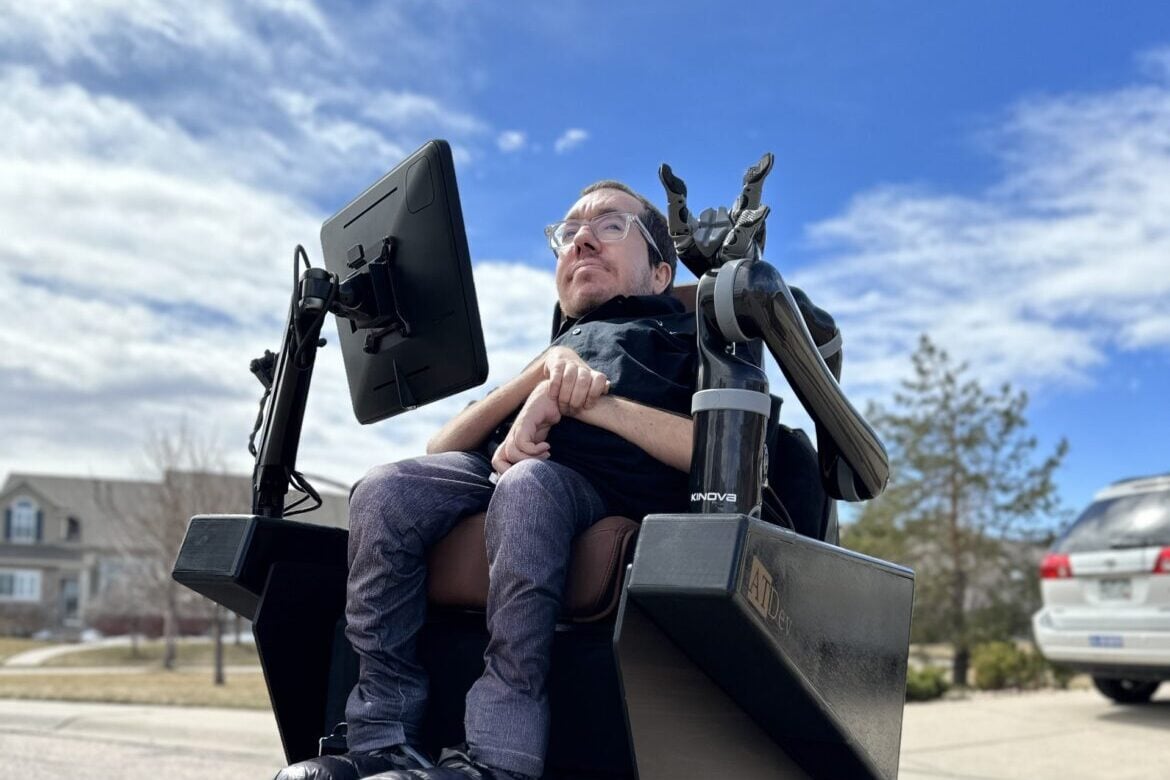
The Center for Data Innovation recently spoke with Owen Kent, chief marketing officer of ATDev, a Pittsburgh-based company developing robotics- and AI-driven assistive technologies. Kent discussed how the company is expanding the existing capabilities of assistive devices to improve mobility, rehabilitation, and independence in users’ lives.
David Kertai: What inspired ATDev’s approach to assistive technology?
Owen Kent: I’ve been a lifelong wheelchair user with muscular dystrophy, and that has given me a prime understanding of how often people with disabilities must navigate systems that weren’t built with them in mind. I saw how gaps in access, affordability, and continuity of care can limit mobility and independence, from inconsistent physical therapy to assistive devices that are difficult to obtain or poorly suited to daily use. Those challenges pushed me toward developing assistive technologies that meet people where they are and adapt to their needs. While at the University of California Berkeley, I met my co-founder, Todd Roberts, and we began exploring how robotics could help close some of those gaps.
That work led to our first product, Reflex, a robotic knee brace designed to support physical therapy remotely. Since then, ATDev has expanded beyond rehabilitation to build assistive technologies focused on mobility and independent living, including robotic rehabilitation devices, mobility systems, and a robotic wheelchair equipped with sensors and an integrated robotic arm to support daily tasks at home.
Kertai: How does Reflex adapt to each patients’ needs?
Kent: Reflex brings physical therapy into the user’s home through an Internet-connected knee brace that clinicians can adjust remotely. Its built-in motor delivers range-of-motion and strengthening exercises while collecting performance data, giving therapists a clear view of a patient’s progress and allowing them to tailor treatment without requiring every appointment to take place in person. This approach is especially helpful for patients who struggle to travel to appointments or live in areas with limited access to physical therapists. Continuous monitoring also lets clinicians follow recovery more closely and intervene sooner when needed.
Kertai: What other robotics and AI-driven devices are you developing?
Kent: Our robotics work focuses on helping people perform more tasks independently. Through a grant from the Advanced Research Projects Agency for Health, we’re developing the Robotic Assistive Manipulation and Mobility Platform (RAMMP), which transforms a power wheelchair into an AI-enabled robotic system that can assist with everyday tasks.
RAMMP uses computer vision to identify objects and activities in the environment and an AI system to interpret the user’s intent. If a user looks toward a refrigerator or reaches toward a cabinet, the system can recognize the objects involved and help determine the intended task. We’re also building a “spectrum of autonomy” that lets users choose how much assistance they want, from full manual control to more autonomous support. This keeps the user in charge while allowing the system to provide assistance when needed.
Kertai: What challenges have you faced in bringing assistive devices into people’s homes?
Kent: One of the biggest challenges is ensuring our technologies are both effective and accessible. We don’t want to build devices that people can’t afford, so we consider insurance reimbursement from the start. Reflex qualifies for reimbursement in many states, allowing eligible patients to receive it at no cost when prescribed.
We take the same approach with our AI-enabled robotic wheelchairs, for which we have established reimbursement pathways through Medicare and other healthcare programs. By building new capabilities into devices people already use and that insurance programs already cover, we can expand what those devices can do without requiring patients to purchase an entirely new type of equipment, helping reduce additional financial barriers.
Kertai: What is your vision for the future of ATDev?
Kent: We want to create an ecosystem of robotic devices that helps people perform everyday tasks and live more independently. Instead of designing entirely new machines for each need, we aim to enhance the tools people already rely on by adding AI, robotics, and purpose-built capabilities. Power wheelchairs already contain the motors, batteries, and actuators needed for mobility, giving us a practical foundation for expanding what they can do.
Our goal is to extend the capabilities of existing assistive devices rather than replace them. This incremental approach makes robotic assistance more realistic and usable, allowing people to adopt new features over time while continuing to use the devices they trust. We see this as a sustainable path toward meaningful, everyday robotic support.


