
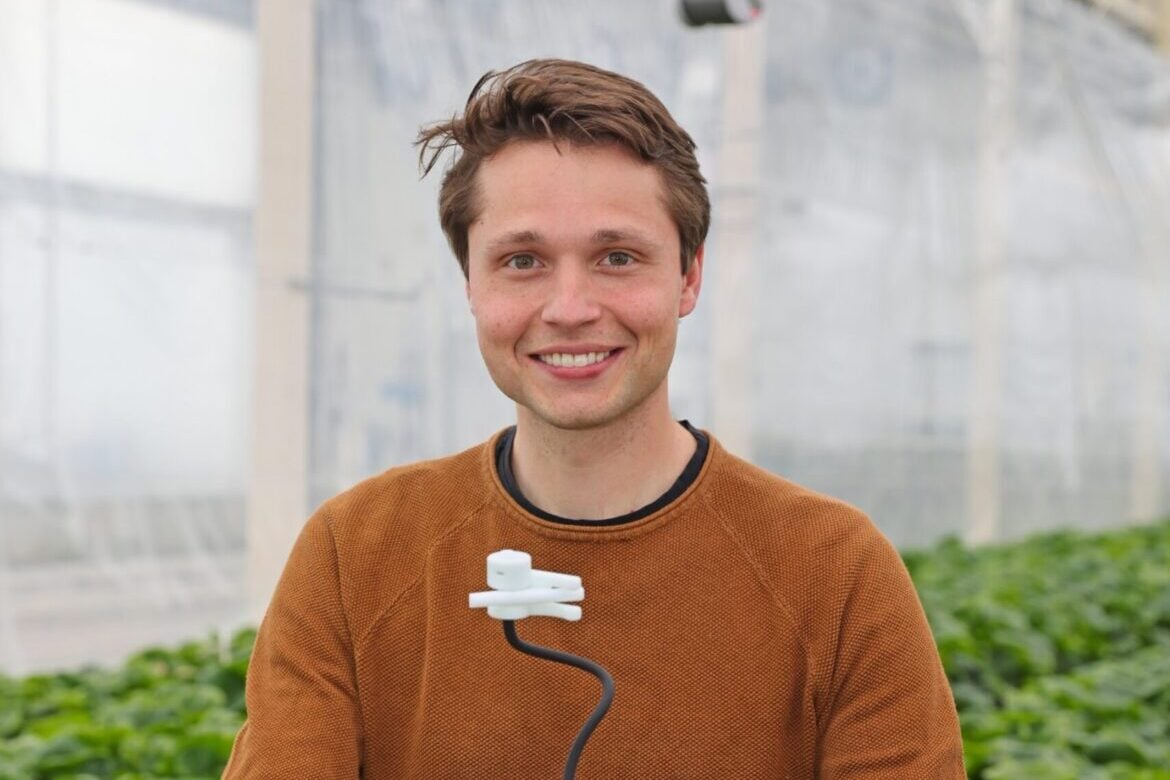
The Center for Data Innovation recently spoke with Olivier Begerem, CEO of Sensie, a Belgium-based company developing an attachable sensor and AI-powered platform that helps greenhouse growers monitor crop health. Begerem explained how the company’s technology measures how crops respond to changing growing conditions, helping farmers make more informed irrigation and climate-management decisions.
David Kertai: What problem is Sensie solving?
Olivier Begerem: Modern greenhouses allow growers to precisely control conditions such as temperature, irrigation, lighting, and humidity. Yet they still struggle to understand how crops are responding to those conditions. Growers often rely on experience and visual inspection to judge plant stress, water balance, and growth, even though crops can show signs of stress long before symptoms become visible.
Sensie addresses this challenge with a small wireless sensor called Omni that attaches directly to the plant and an AI-powered software platform that interprets the sensor data. Together, they combine measurements from the plant, its root zone, and the surrounding environment to show how the crop is responding in real time. Growers receive clear indicators of growth, stress, water balance, and recovery, allowing them to adjust cultivation based on the plant’s actual condition.
Kertai: Why do traditional climate and soil sensors only tell part of the story about crop health?
Begerem: Climate and soil sensors remain essential because they measure the conditions surrounding the plant, but they cannot show how the plant actually responds. Two crops growing under the same temperature, irrigation, and lighting conditions may behave very differently depending on factors such as growth stage, fruit load, root activity, or accumulated stress. To fully understand crop health, growers need to connect three layers: the resources available to the plant, the demands placed on it by the environment, and the plant’s own biological response.
Without that final layer, growers must infer crop health indirectly. Measuring the plant itself provides early evidence of whether current growing conditions are supporting healthy growth or creating stress before visible symptoms appear.
Kertai: How does Omni measure a plant’s response to growing conditions?
Begerem: Omni combines three layers into a single device by measuring root-zone conditions, including moisture, temperature, and electrical conductivity, which indicates the concentration of dissolved nutrients available to the plant. It also measures environmental conditions such as temperature, humidity, light, and vapor pressure deficit, which describes how strongly the air draws moisture from plants. Most importantly, it measures tiny changes in stem diameter that reveal growth, water balance, stress, and recovery.
By analyzing these measurements together, Omni not only shows what is happening to the plant but also helps explain why. Growers gain a real-time view of crop health instead of relying only on environmental measurements.
Kertai: How does your AI-powered platform identify potential issues?
Begerem: The AI platform compares changes inside the plant with changes in temperature, humidity, irrigation, and root conditions. Rather than simply reporting environmental measurements, it determines whether those changes are actually affecting plant health. This allows growers to detect rising stress levels, monitor recovery after irrigation, and identify which environmental factors are driving changes in crop performance.
The platform then translates complex sensor data into simple plant-health indicators and alerts. Instead of interpreting dozens of measurements themselves, growers receive clear guidance on where they may need to adjust irrigation, ventilation, shading, nutrient delivery, or other climate-management strategies. Growers remain in control, but every decision is supported by objective measurements from the plant.
Kertai: Could you share any examples of Sensie helping a farmer improve crop performance?
Begerem: One greenhouse grower wanted to fine-tune irrigation for a high-value crop and tested two different watering schedules in neighboring rows. Traditional climate sensors suggested both approaches were performing similarly, but Sensie revealed an important difference. Although both groups of plants recovered overnight, one irrigation strategy consistently caused significantly more daytime stress.
That insight allowed the grower to choose the watering strategy that reduced plant stress while maintaining healthy growth. Instead of relying only on environmental measurements, the grower could base irrigation decisions on direct feedback from the crop, improving confidence that water was being applied where and when it was needed most.


