
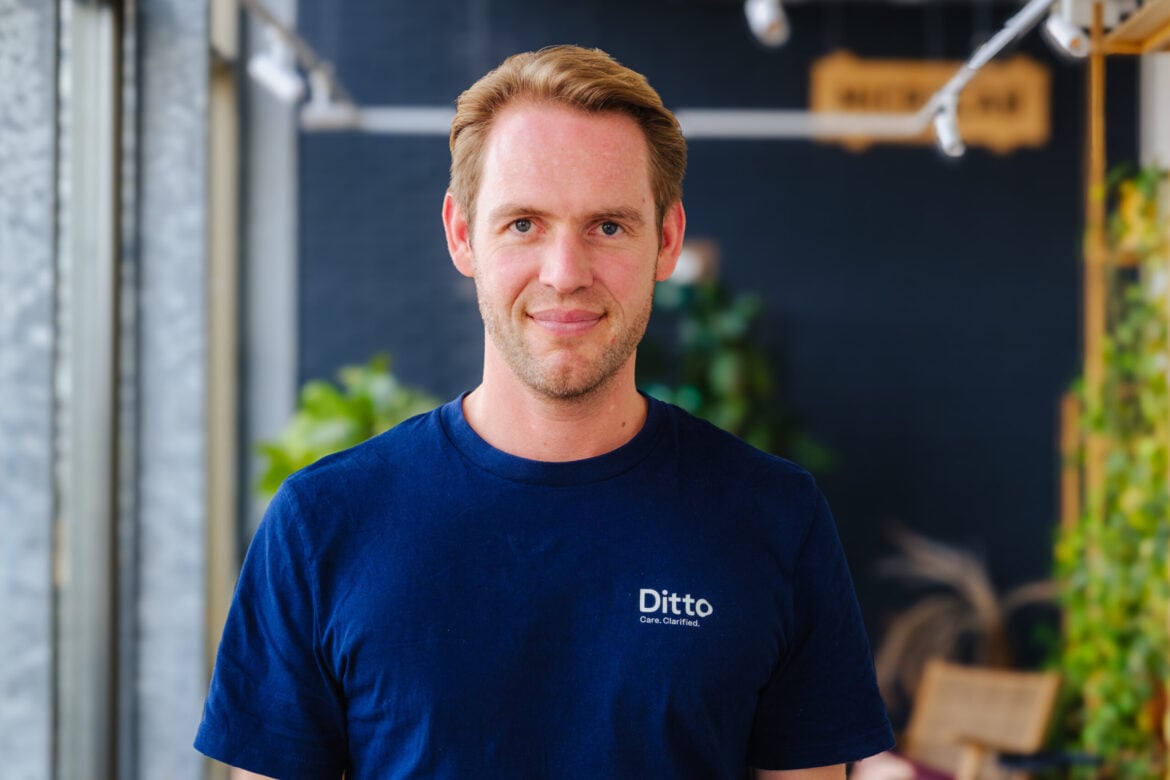
The Center for Data Innovation recently spoke with Bart Voorn, founder of Ditto Care, a Netherlands-based company developing an AI-powered app that helps patients better understand medical appointments and health information. Voorn explained how Ditto records and summarizes consultations, translates complex medical language into understandable terms, and helps patients prepare for future appointments with personalized questions and guidance.
David Kertai: What inspired Ditto Care’s creation?
Bart Voorn: Most people leave medical appointments having understood and retained only a small fraction of what was discussed. Ditto grew directly out of that reality. One of our co-founders, Tobias, accompanied a friend with stage-4 bile-duct cancer to an oncology appointment and realized afterward that they had walked away with completely different understandings of the doctor’s explanation. I had a similar experience after being diagnosed with Type 1 diabetes and struggled to explain my condition to friends and family.
This problem is widespread. Research on patient recall shows that people understand only 20 to 40 percent of what clinicians communicate, and that number drops even further when patients receive serious news or face language barriers. Meanwhile, most AI innovation in healthcare focuses on helping clinicians with tasks such as note-taking, triage, or chart completion. Very few tools are designed specifically for patients.
Ditto aims to close this gap by giving patients an AI-powered mobile app that helps them better understand their healthcare. The app records, transcribes, and, when needed, translates complex medical information into clear, accessible language. Patients can review diagnoses, ask informed questions, and follow treatment plans with greater confidence. Rather than helping clinicians manage paperwork or administrative tasks, Ditto focuses on helping patients better understand and participate in their own care.
Kertai: How does your platform connect with patients’ medical appointments and records?
Voorn: Ditto is designed entirely for patients, so it doesn’t connect directly to hospital backend systems. Instead, it travels with patients throughout their care journey. With a patient’s permission, the app records conversations during appointments, transcribes them, and automatically generates structured summaries that patients can revisit, share, and use to prepare for future visits.
The platform also allows patients to photograph medical letters, test results, and other healthcare documents and receive explanations in plain language. Because Ditto isn’t tied to a single healthcare provider, it helps patients manage information across their entire care journey, from primary-care visits to specialist appointments in areas such as cardiology and oncology.
Kertai: How does your AI model identify and suggest questions relevant to a patient’s upcoming appointment?
Voorn: Ditto suggests questions for future appointments by analyzing information from previous consultations, diagnoses, treatment plans, medications, and uploaded medical documents. Rather than providing generic question lists, the system identifies topics that may need clarification based on each patient’s specific situation.
We continue to invest heavily in this area. The system builds these recommendations using the same AI pipeline that generates appointment summaries, allowing it to connect information across visits and help patients prepare more effectively. We are also developing visual care-journey tools that guide patients and their families through treatment over time.
Kertai: How does your platform translate complex medical information into language patients can easily understand?
Voorn: Instead of building our own large AI model from scratch, we build on advanced general-purpose AI models developed by leading AI companies. This approach allows us to focus on solving patient-specific problems while taking advantage of the latest advances in AI technology. Around that core, we use a specialized speech-recognition model, Grutto, and additional AI language models that identify languages, explain medical concepts, simplify terminology, and translate information when needed.
We continuously evaluate the system’s outputs using automated testing and feedback from both doctors and patients. The platform assigns confidence scores to identify potentially ambiguous information, such as conflicting medication dosages. It also compares key details against trusted medical references to verify medication names and other important information. If the system detects a potential inconsistency, it does not generate a summary. Instead, one of our doctors reviews the information and can create a summary manually.
Kertai: What challenges have you faced building this for healthcare?
Voorn: The first challenge is cultural. Healthcare systems do not always prioritize the patient experience, so taking a patient-first approach can sometimes lead to reactions such as, “We already have a patient portal.” We often need to demonstrate that helping patients better understand their care solves a different problem.
On the technical side, AI hallucinations, instances where a system generates incorrect information that sounds convincing, remain the biggest challenge. A summary may be nearly perfect except for one incorrect medication name or dosage, which could create serious risks. That is why we have built validation systems, guardrails, and automatic suppression mechanisms.
Building trust has also been critical, especially because the platform records medical conversations. Some clinicians embrace the technology immediately, while others initially raise privacy concerns. We have found that allowing clinicians to try the app themselves often changes their perspective, and many ultimately recommend it to their patients.


