
This week’s roundup of data news highlights from September 19, 2026, to September 25, 2026, features Google testing AI-driven computing in space and a robotic system taking over tire changes at a Canadian shop.
1. Managing Air Traffic
The Federal Aviation Administration has launched its SMART platform, an AI-powered system designed to improve how airspace is managed. It analyzes more than 200 data streams, including weather, traffic flow, and staffing, to predict demand and recommend more efficient routes. By giving specialists earlier insight into potential constraints, the tool aims to reduce delays, cut fuel waste and make flight operations more predictable as the system expands nationwide.
2. Testing Computing in Space
Google has built an experimental satellite for Project Suncatcher, an initiative exploring whether AI data centers could eventually operate in space. The satellite carries TPU chips, specialized processors for AI workloads, along with a custom radiator system to manage heat. It will run short Gemini queries while enduring radiation and extreme temperatures, testing whether orbital computing could one day scale into clusters powered by abundant solar energy.
3. Sorting Plastic Efficiently
Recycling site Biffa Polymers in Redcar, UK, has integrated an AI system to speed up the transformation of old milk bottles into new ones. The system analyzes waste moving along conveyor belts using optical, infrared, and image-based detection to identify HDPE, a common type of plastic, even when bottles are crushed or distorted. The center aims to improve sorting quality and efficiency while keeping workers focused on higher-value tasks.
4. Tracking City Legislation
Former Seattle City Council President Sara Nelson has created CivicTide, a new site that uses AI agents to track legislation and streamline public engagement. The platform ingests council data hourly, drafts policy briefs and gives Nelson a ranked queue of issues to cover, with every post reviewed and edited by her before publication. It also lets users contact council members and share their views on proposals.
5. Streamlining Video Creation
YouTube has released a new feature that uses an AI system to help creators refine their videos and understand what may attract audiences. The system can analyze draft uploads for pacing, structure, and storytelling, generate titles and thumbnails matched to a creator’s style, and compare different options. These features aim to help creators identify what drives engagement and optimize both new and existing content more efficiently.
6. Improving Running Form
Peloton has announced its new Tread Vision treadmills, which use an AI‑powered camera and sensor system to assess a runner’s form in real time. The models analyze cadence, vertical oscillation—how much a runner moves up and down—and repetitions during strength intervals. By monitoring how a runner moves rather than just how fast they go, the system aims to provide more personalized training and help users improve their technique.
7. Automating Tire Changes
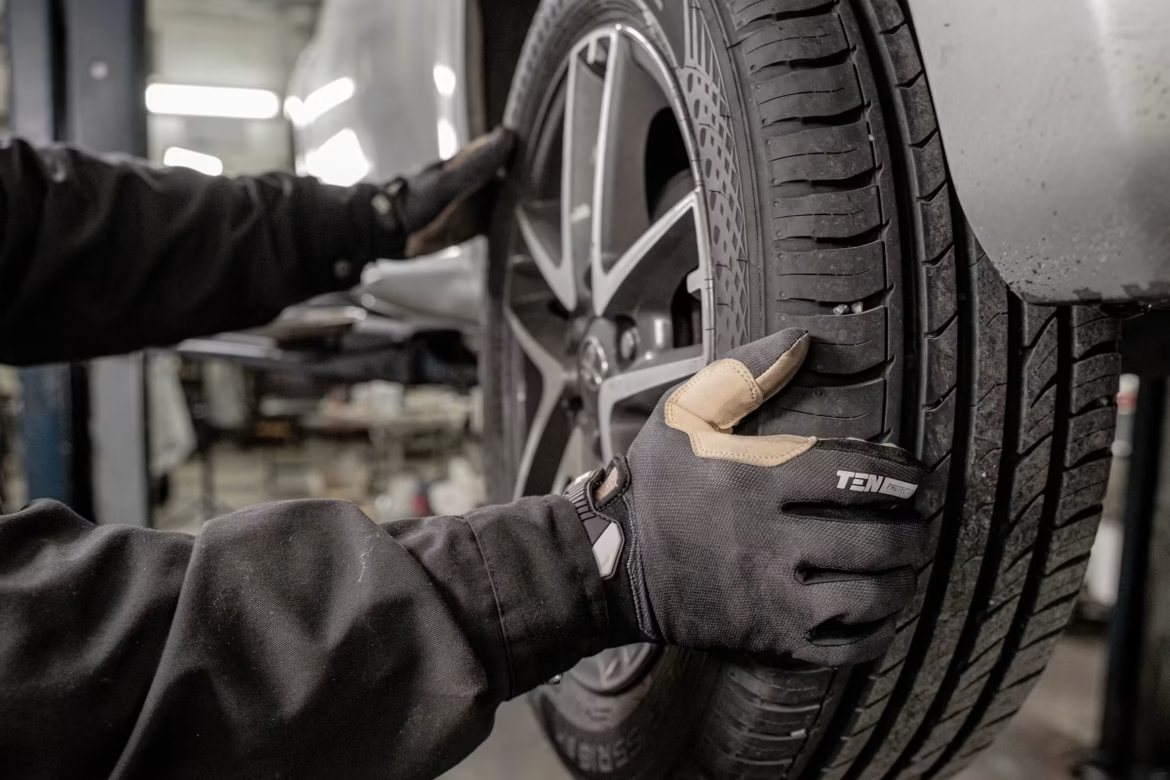
San Francisco startup PitPro Automation has built its first real-world robotic system for fully automated tire changes in Calgary, Alberta. The setup uses paired robots equipped with sensors and a precision arm to identify each wheel, locate and loosen lug nuts, remove the tire. and mount a replacement. The system is designed to maintain an accurate view of the vehicle despite dust, debris, and changing shop conditions.
8. Discovering Bacterial DNA
Researchers at Anthropic have used Claude to identify a previously unknown enzyme system in bacterial DNA that shows a pattern similar to CRISPR, a gene‑editing technology. Claude surfaced the sequence after 21 hours of autonomous analysis, flagging features seen in only a few known programmable systems. The finding could open the door to new gene‑editing approaches by revealing patterns that help scientists design more precise editing tools.
9. Monitoring Livestock
Researchers at North Carolina Agricultural and Technical State University and North Carolina State University have tested how AI-powered analysis and precision livestock tools can improve conditions for hogs. Researchers used sensors, behavior-monitoring systems, and programmable controllers that detect stress and translate animal responses into data. The project aims to show how AI-driven livestock management can support animal welfare and farm efficiency.
10. Accelerating Space Travel
California‑based space-tech startup AstroForge has announced Solo, an AI-powered autonomous control system to help spacecraft diagnose and resolve problems without human input. Trained on thousands of onboard sensor readings and paired with traditional control algorithms, Solo can spot anomalies, link failures across subsystems and take corrective action. The system is designed to let future deep‑space missions operate more independently.


