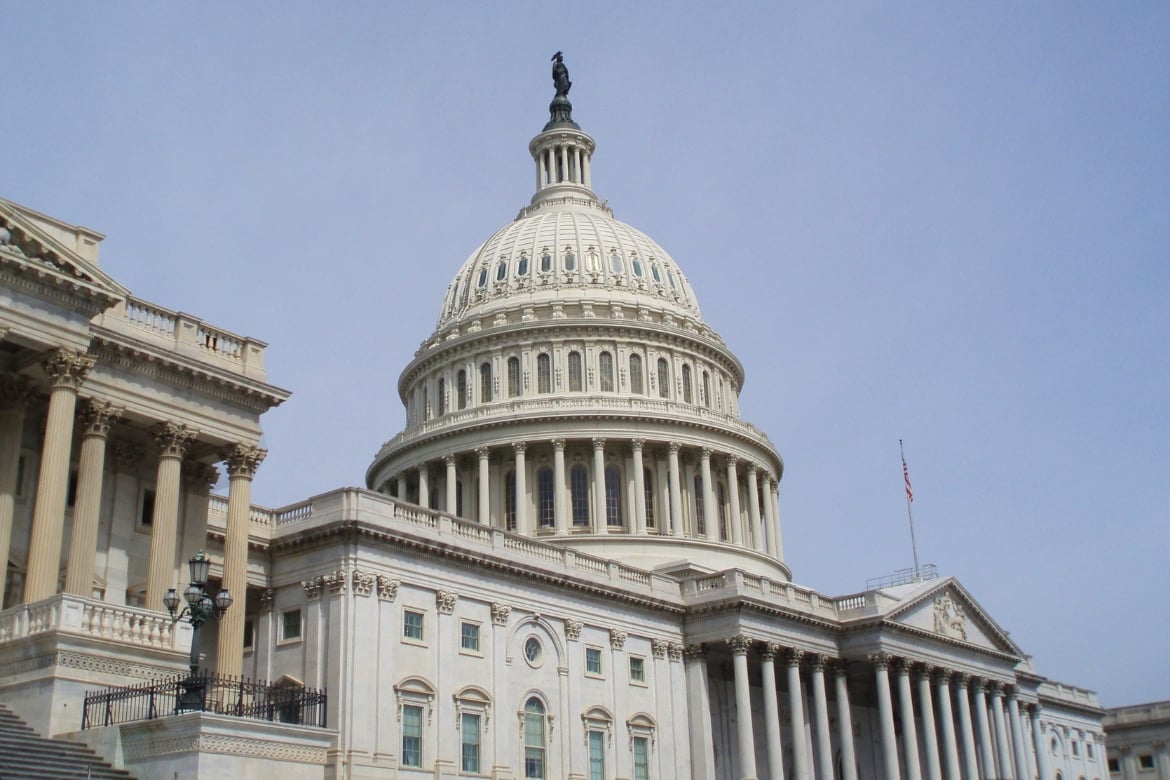
Congress faces a consequential choice about the direction of U.S. artificial intelligence (AI) policy. One possible path is an alliance between progressive Democrats and populist Republicans who share a desire to curb the influence of major technology companies and constrain the pace of AI development. The alternative is a coalition of pragmatic Democrats and Republicans focused on strengthening American AI leadership, accelerating adoption, and ensuring the technology delivers tangible benefits for ordinary Americans. These competing bipartisan approaches would produce very different policy agendas, with lasting consequences for U.S. competitiveness and economic growth.
The political debate over AI is often framed as a contest between those who want minimal government intervention and those who favor sweeping restrictions. A recent Third Way memo, “Tech Realism,” illustrates this framing by describing a divide between “Reckless Optimists,” who oppose meaningful oversight of AI, and “Reactionary Pessimists,” who want to ban or indefinitely pause these technologies. Its proposed middle ground emphasizes safety guardrails, consumer protection, and preparing workers for disruption while allowing innovation to proceed. These are important priorities, but they leave out a central question: What should government do to help AI deliver broad economic and social benefits? The debate should encompass not only the right rules for managing AI’s risks, but also the policies needed to accelerate its development and adoption across the economy, including in health care, education, and manufacturing. The political divide is therefore about more than how much to regulate AI. It is also about whether Congress will pursue an affirmative agenda to help Americans benefit from the technology.
One potential coalition brings together the populist left and populist right. Despite their differences on most economic and social issues, these groups share deep skepticism toward large technology companies and the economic changes driven by AI. Progressive critics portray AI companies as threatening workers, harming children, undermining democracy, and prioritizing profits over the public interest. Populist conservatives increasingly raise similar concerns, pointing to potential job losses, children’s exposure to technology, environmental impacts, and the concentration of corporate power. The emerging alliance between MAGA proponent Steve Bannon and progressive icon Sen. Bernie Sanders around a so-called pro-human AI movement illustrates this unlikely convergence.
A bipartisan agenda built around this coalition would likely emphasize restrictions on AI development and deployment. It could include data center construction moratoriums, AI development pauses, sweeping restrictions on children’s access to AI products, and expansive regulations covering everything from model safety to competition policy. It could also include proposals to heavily tax AI companies or give the public a direct stake in their wealth through sovereign wealth funds. These ideas reflect a shared desire to redistribute the gains from AI and constrain the power of major technology companies. Some individual proposals may address legitimate concerns, but taken together, this agenda risks constraining American AI companies and limiting the economic benefits of the technology.
The alternative is a pragmatic, pro-innovation coalition that brings together Democrats and Republicans who recognize the economic importance of AI and want to ensure its benefits reach ordinary Americans. Neither party is ideologically uniform on the issue. Some Democratic governors, including Maura Healey of Massachusetts and Gretchen Whitmer of Michigan, have recognized the importance of data center investments and pushed back against blanket opposition to new facilities. Republicans, meanwhile, have shown interest in addressing concerns about electricity costs and environmental impacts, while lawmakers from both parties are beginning to examine how AI will affect workers and what skills they will need in the changing economy. These shared interests create opportunities for practical bipartisan policymaking.
An agenda built around this coalition would combine sensible safeguards with a more ambitious commitment to innovation and scientific progress. It could include protections to ensure data center operators pay their fair share of electricity costs, environmental performance standards, greater federal investment in AI safety research and development, and support for the Center for Advancing Innovation and Standards for Super Intelligence (CAISSI). It should also make accelerating scientific discovery a central national priority. Government can advance this goal by investing in AI-enabled research, removing unnecessary barriers to experimentation, and helping translate breakthroughs into practical applications across health care, energy, manufacturing, and other sectors. Policymakers should prioritize AI adoption in health care, education, and transportation, where the technology can improve services and reduce costs.
The approach to workers should reflect the same emphasis on accelerating progress. Third Way’s focus on retraining and strengthening the social safety net is primarily about protecting workers from the disruption caused by AI. Those measures have a role, but a pro-innovation agenda should go further by accelerating workers’ transitions into more productive jobs. That means helping businesses adopt new technologies, redesign jobs, and create opportunities in emerging industries. A national robotics strategy, for example, could coordinate investments in robotics adoption, workforce development, and the industries that will create new jobs as automation expands. The objective should be to help workers move into better opportunities as technological change creates them, rather than focusing primarily on cushioning the effects of displacement.
This is an affordability and abundance agenda: accelerating AI development and adoption while ensuring that Americans share in the resulting gains.
The 2026 midterm elections offer a broader lesson for Congress as it considers AI policy. Voters have expressed frustration with policies that have made everyday life more expensive, including tariffs and the war in Iran. Members of Congress risk making similar political mistakes if they embrace popular-sounding positions without considering their practical consequences. Public frustration with the costs and disruptions associated with AI should not automatically translate into support for policies that restrict data center investment, slow AI development, or limit adoption. Policymakers need to address legitimate concerns about the technology while also recognizing its potential to make health care more effective, education more accessible, businesses more productive, and everyday life more affordable. The goal should be to develop policies that make AI deliver better outcomes for Americans, rather than assuming that restricting its development will prevent the changes people fear.
Congress has an opportunity to build a bipartisan AI agenda that goes beyond managing risks to actively advancing American innovation, scientific discovery, and widespread adoption. That means not only establishing appropriate safeguards, but also investing in the infrastructure, research, and workforce transitions needed to turn AI breakthroughs into tangible improvements in people’s lives. The alternative is an agenda focused primarily on constraining the companies and technologies driving this transformation. Congress should measure success not by how much it limits AI, but by how much it helps Americans benefit from it.
Image credit: Dark146/Flickr